WORKOUT
Walking pad workout plan: 4 weeks from 10 to 30 minutes
A four-week walking pad plan for beginners, with steady walks, easy intervals and desk walking, plus the floor space each pad needs.
General fitness information, not medical advice. Check with a doctor before starting if you have an injury, a health condition, or haven’t trained in a while. Stop any exercise that causes pain.
Gear you need
Our first pick in each category this workout uses. Every option is compared by the space it needs when you put it away.
As an Amazon Associate I earn from qualifying purchases. It doesn’t change our picks or your price. Affiliate disclosure
#1Shortest in use
Stored size
38.39 × 21.86 × 6.89 in
On its feet, fully assembled
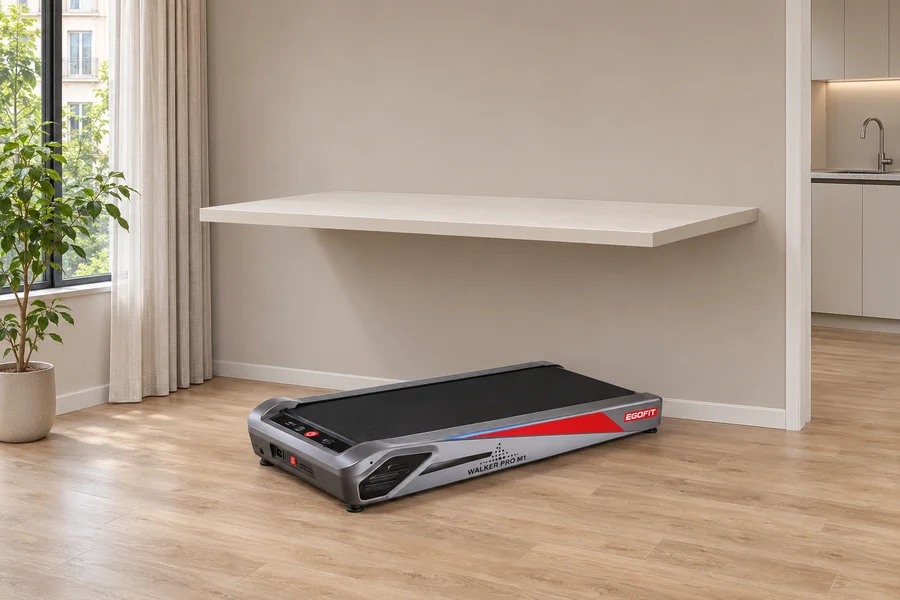
Egofit
Walker Pro M1
Fixed deck, no handrail
At 38.4 inches long in use, this is the shortest of the four to leave beside a desk.
Paid link
This plan takes you from short 10-minute walks to 30 minutes at a brisk pace in four weeks, on any walking pad. You walk four or five days a week: most days at a steady pace, and once or twice with short faster stretches. If you work at a standing desk, the slow desk walks at the end count as extra movement, not as workouts.
It suits you if you are starting from little or no exercise, coming back after a break, or want a low-impact habit you can fit around work, in a room that has no space for a full treadmill.
Space you need
- The pad. The walking pads we compare are 38.4 to 56.9 inches long and 20.4 to 21.9 inches wide when set up. Mark the outline on the floor with tape before you buy.
- Behind it. Keep about 2 feet clear behind the deck, with nothing you could step back onto, such as a chair, a rug edge or a cable.
- At a desk. The pad has to fit between the desk legs, and the desk needs to sit at elbow height while you stand on the deck. The short Egofit M1 is made for this; the folding pads are longer.
- Above you. Walking adds a few inches to your height on the deck. Check low lights and shelves.
Afterwards, a folding pad goes under the bed or sofa: the WalkingPad P1 folds to 32.4 × 21.5 × 5.1 inches. The walking pad comparison gives each model’s open and folded size, and the Fit Finder checks it against your gap.
How hard to walk
Walking pads show speed differently, so this plan uses effort instead of numbers:
- Easy: you could hold a full conversation or sing.
- Steady: you can talk in full sentences, but you’re breathing more deeply.
- Brisk: you can talk in short phrases only. This is the pace for the faster stretches.
If your pad has an incline, such as the Egofit M1’s fixed 5% or the TRAILVIBER X01’s levels up to 12%, use it only once the flat walks feel easy.
Your week
| Week | Steady walks | Interval walk | Total walks |
|---|---|---|---|
| 1 | 3 × 10 min | — | 3 |
| 2 | 3 × 15 min | 1 × 15 min | 4 |
| 3 | 3 × 20 min | 1 × 20 min | 4 |
| 4 | 3 × 25–30 min | 2 × 20 min | 5 |
- Spread them out: walking is gentle enough to do on consecutive days, but take at least one full day off a week.
- Interval walks: after 3 minutes easy, alternate 1 minute brisk with 2 minutes steady, and finish with 3 minutes easy.
- If a week felt hard: repeat it before moving on. There’s no prize for finishing in four weeks.
- With strength work: pair two walks a week with the dumbbell and bench workout or the band workout on other days.
Warm-up and cool-down
Start every walk with 3 minutes at an easy pace and finish with 2 to 3 minutes easy. Step off and stretch your calves and the front of your hips for 30 seconds each side.
How to walk on a pad
- Look ahead, not down. Keep your head up and your shoulders relaxed.
- Stay in the middle of the belt. If you drift towards the back, slow down.
- Take shorter steps than outdoors. The belt is shorter than a pavement, and a short, quick step is more comfortable.
- Start and stop at the slowest speed. Step on with the belt still or slow, and lower the speed before you step off.
Easier or harder
| Goal | Easier | Harder |
|---|---|---|
| Steady walks | Split them into two 5–10 minute walks | Add 5 minutes per walk |
| Interval walks | 30 seconds brisk instead of 1 minute | 2 minutes brisk, 2 minutes steady |
| Effort | Lower the speed a step | Add incline, if your pad has it |
After week 4
Keep three steady walks and one or two interval walks a week. Then raise one thing at a time: a few minutes more, a little more speed, or incline if your pad has it.
Desk walking
At a standing desk, walk at an easy pace you can type at, for 15 to 30 minutes at a time, and stand or sit in between. Typing and walking fast don’t mix: keep the brisk stretches for your workouts.
Safety
- If your pad has a safety clip or key, attach it to your clothing.
- Keep children and pets away from the belt while it moves, and unplug the pad when it’s stored.
- Stop if you feel dizzy, short of breath or chest pain, and get medical advice before continuing.
Common questions
Is a walking pad enough exercise?
For a beginner, regular brisk walking is a good start. Add strength work twice a week for the rest of the body.
Can I run on a walking pad?
Most walking pads are designed for walking, not running. Check your model’s maximum speed and the manual before going faster.
How long should I walk at my desk?
Walk easy for 15 to 30 minutes at a time and alternate with standing or sitting. It adds movement to your day, but it doesn’t replace your planned walks.