WORKOUT
20-minute rowing machine workout for beginners
A 20-minute beginner rowing workout with easy intervals, the stroke sequence step by step, a 4-week plan and the floor space compact rowers need.
General fitness information, not medical advice. Check with a doctor before starting if you have an injury, a health condition, or haven’t trained in a while. Stop any exercise that causes pain.
Gear you need
Our first pick in each category this workout uses. Every option is compared by the space it needs when you put it away.
As an Amazon Associate I earn from qualifying purchases. It doesn’t change our picks or your price. Affiliate disclosure
#1Shortest in use
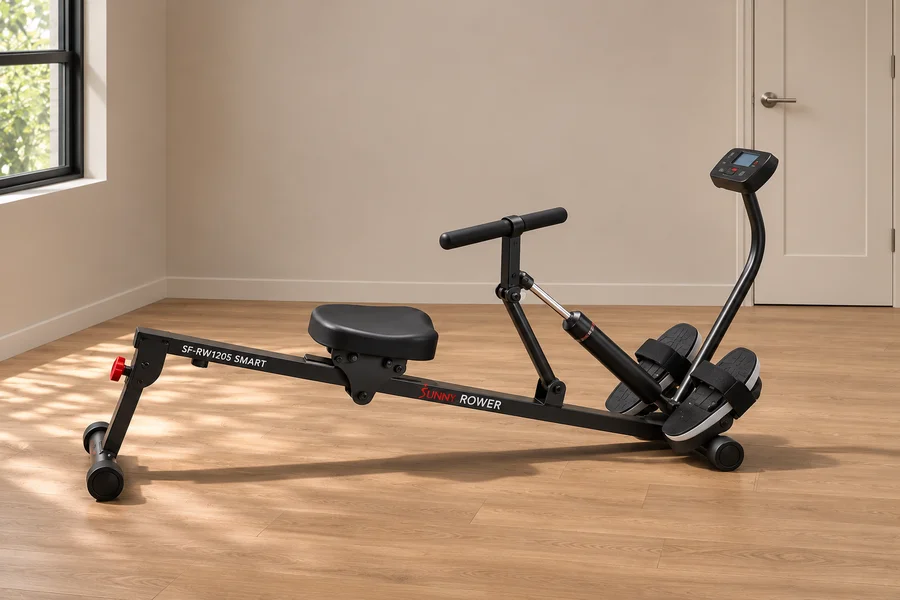
Stored size
58.1 × 20.1 × 24.8 in
Assembled, resting on its feet
Sunny Health & Fitness
SF-RW1205SMART
Smart compact hydraulic rower
At 58.1 inches long, this is the shortest assembled frame of the four. It can stay on its feet in the same corner between sessions.
Paid link
This workout is 20 minutes long: a warm-up, seven short rounds of steady rowing with an easy minute after each, and a cool-down. Do it three times a week for four weeks, making each round a little longer. It works on any home rower: air, magnetic, water or hydraulic.
It suits you if you are new to rowing, or to cardio in general, and want a low-impact workout that uses your legs, back and arms together, in a room where the rower can be stood up or folded away afterwards.
Space you need
- Length. The rowers we compare that publish their size in use are 58.1 to 81.8 inches long. Leave about 2 feet clear at each end: in front for the handle and your hands, behind for the seat at the end of the slide.
- Width. They are 18.9 to 22 inches wide. Keep a little room on each side for your hands as you climb on and off.
- Floor. A rubber mat under the rower protects the floor and stops it creeping.
Several rowers stand upright, fold or separate between workouts. The XTERRA ERG600W stands on its tank end at 33 × 22 inches, the Sunny SF-RW5515 folds its rail up to 43.3 × 18.9 inches, and the Concept2 RowErg separates into two pieces that park together in 25 × 33 inches. The rowing machine comparison lists each one’s stored size, and the Fit Finder checks it against your space.
Before you start: the stroke
Every stroke has the same order. Practise it slowly for a few minutes before your first workout.
- Catch. Sit tall, shins close to vertical, arms straight, holding the handle lightly.
- Legs. Push with your legs first. Your arms stay straight.
- Body. As your legs straighten, lean back slightly from the hips.
- Arms. Finally, pull the handle to just below your ribs, elbows past your body.
- Return. Reverse the order: arms away, lean forward, then bend your knees and slide back to the catch.
A simple rule: legs, body, arms on the way back, arms, body, legs on the way forward. Take more time returning than pulling.
How hard to row
- Easy: you could hold a conversation.
- Moderate: you can say short sentences, breathing harder.
If your monitor shows strokes per minute, keep it around 18 to 24 in this plan. Power comes from a stronger push with the legs, not a faster stroke. Choose a middle resistance setting: if the setting is too heavy, your back and arms tire before your legs.
The workout
| Part | Time | Effort |
|---|---|---|
| Warm-up | 3 min | Easy, practising the order of the stroke |
| Main set | 7 × (1 min moderate + 1 min easy) | 14 min in total |
| Cool-down | 3 min | Easy, getting slower |
Your week
| Week | Main set | Total time |
|---|---|---|
| 1 | 7 × (1 min moderate + 1 min easy) | 20 min |
| 2 | 5 × (2 min moderate + 1 min easy) | 21 min |
| 3 | 4 × (3 min moderate + 1 min easy) | 22 min |
| 4 | 3 × (4 min moderate + 1 min easy) | 21 min |
- Three times a week, for example Monday, Wednesday and Friday. The day off lets your hands and lower back adapt.
- If you miss a session, carry on from the next one. Don’t row two days running to catch up.
- With strength work: row twice a week and do the dumbbell and bench workout on one other day.
Easier or harder
| Goal | Easier | Harder |
|---|---|---|
| Main set | 30 seconds moderate, 1 minute easy | Add one round |
| Resistance | One setting lower | One setting higher, keeping the same stroke rate |
| Technique | Legs and arms only, without leaning back | Pause briefly at the catch on each stroke |
After week 4
Row a continuous 15 to 20 minutes at a moderate effort once a week, and keep one interval session. Then add a few minutes or one round at a time.
Common mistakes
- Pulling with the arms first. Your legs do most of the work: wait to bend your arms until your legs are nearly straight.
- Rounding the back. Sit tall and hinge from the hips.
- Rushing the return. Slide forward slowly; that’s your recovery within each stroke.
Safety
Read your rower’s manual for setup and resistance. Hydraulic and water rowers feel different from air and magnetic ones. Stop if you feel back pain, dizziness or chest pain, and get medical advice before continuing.
Common questions
Is 20 minutes of rowing enough?
For a beginner, yes. Three 20-minute sessions a week is a solid start. Add time gradually once the plan feels easy.
What resistance should a beginner use?
A middle setting. If you feel it more in your arms and lower back than in your legs, turn it down.
Is rowing good for a small apartment?
Air rowers make a whooshing noise and water rowers a gentle splash. Magnetic rowers are usually the quietest. A mat underneath reduces vibration on the floor.